
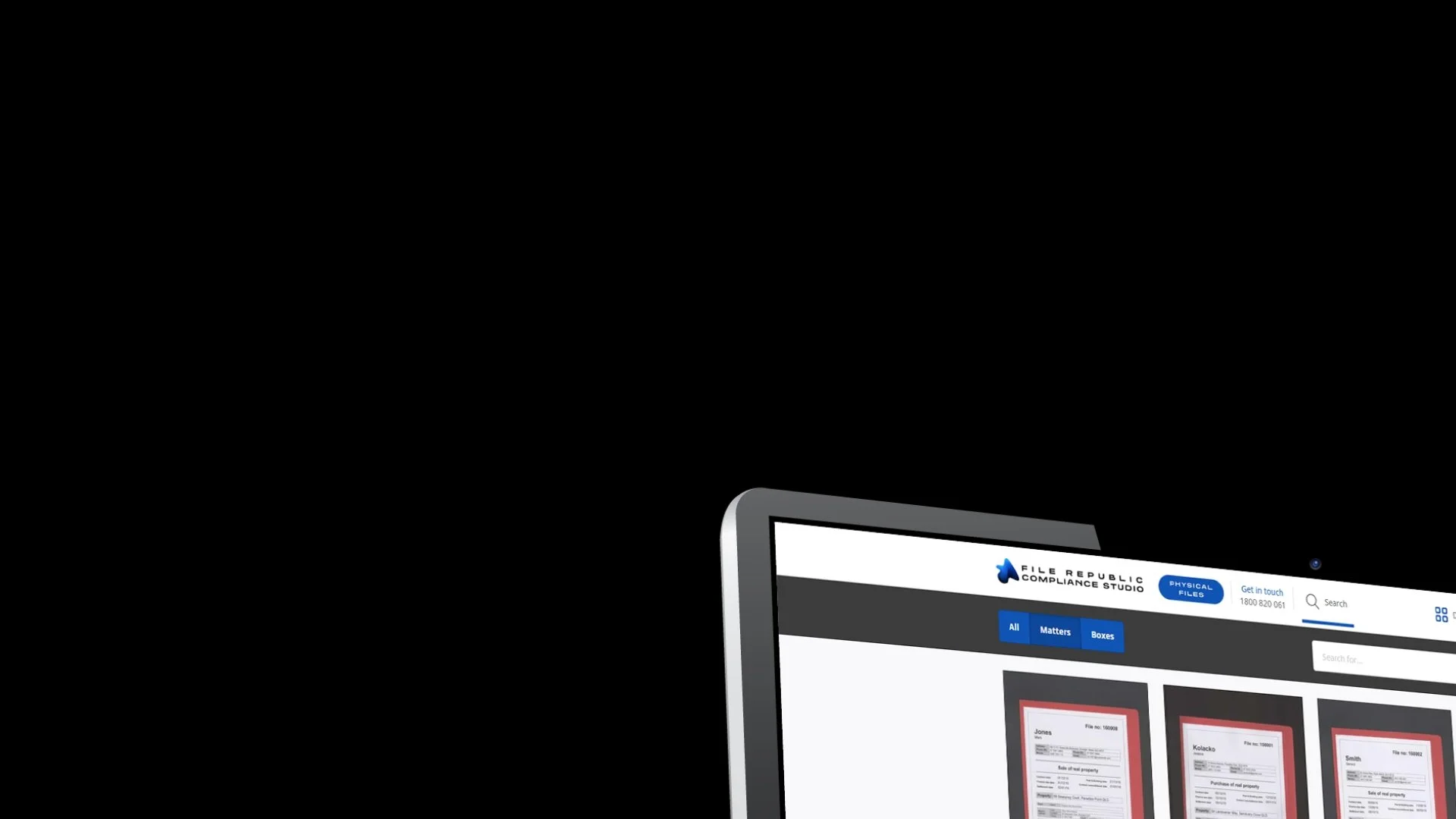
We collect, store and manage closed physical files at no cost*.
*‘No cost’ means that File Republic charges per matter or per bundle, allowing law firms to recover these fees from clients as a cost recovery. Pricing is designed not to create an additional overhead for the firm.
The matter closed.
Your obligation didn’t.
Closing a matter ends the legal work. It does not end your duty to the file. In the UK, a firm must keep closed files secure, confidential and able to be produced for years after the matter is done. Paper is no exception. A box in a cupboard is still personal data, and it still carries the obligation.
Organised and controlled
The firm must keep client information organised and controlled from the point it is received, with security measures in place and a documented record of what it holds, why, and for how long.
UK GDPR arts 5(1)(f), 24(1), 30(1). SRA Code of Conduct for Firms para 2.1(a).
True redaction & minimisation
The firm must hold only the personal data each purpose requires, and by default no more than that. Exposure should be reduced where full identity details are no longer needed. Third party data is redacted from access responses. Redaction must remove the data, not mask it.
UK GDPR arts 5(1)(c), 25(2). DPA 2018 sch 2 para 16, s 171.
Storage is not a retention policy
The firm must not keep personal data longer than necessary, but must retain records where another law or rule requires it. Accounting records are kept at least six years, AML records five years, and limitation periods of six, twelve and fifteen years drive retention by matter type. Retention periods must be documented.
UK GDPR arts 5(1)(e), 30(1). SRA Accounts Rules rule 13.1. MLR 2017 reg 40(3). Limitation Act 1980 ss 2, 5, 8, 14B.
Becoming truly paperless.
We’ve transformed thousands of firms into paperless, compliant and efficient organisations in three simple steps.
-
Your legacy files are collected
Your files are transported to our facility at no cost*
Your file covers are scanned and barcoded
Your files are placed into an RFID tagged box
Your files are indexed using metadata
Your file details are uploaded to a secure, searchable portal for 24/7 access
-
Your files are easily searchable should you require them quickly
Scanned copies are easily requested via the portal
Physical copies can be returned upon request**
Retention dates can be set and amended via the portal and secure, compliant destruction arranged upon request
-
New matter collection can be regularly scheduled or arranged upon request
All new matters are front cover scanned, barcoded, indexed, placed into an RFID tagged box and details uploaded to your secure portal
New matters are charged using an up-front, one-time per matter charge making them disbursable to your clients.
*Subject to fair use. **Charges may apply.
All of our services, none of the cost*
A single, all-inclusive fee applies per new matter.
Charges can be automatically recorded against the client ledger in your practice management system**.
The fee is fully recoverable as a client cost recovery, designed for no out-of-pocket cost to the firm.
Lower storage expenses, improve productivity, and strengthen compliance processes.
*Services are designed to be recoverable from clients due to per-matter billing **Automatic recording where integration is enabled
More than compliance.
Advanced Physical Security: Storage centres are fortified with perimeter fencing, 24/7 security personnel, continuous video surveillance, and stringent, multi-factor access controls to prevent any unauthorised entry.
Optimal Preservation: State-of-the-art environment control systems help to protect your files and their longevity.
State-of-the-Art Fire Protection: Highly advanced fire suppression systems are designed to extinguish any threat swiftly and effectively, often using specialised methods that protect paper records from water damage.
Strict Access Protocols: Every file is meticulously tracked, and access is restricted to authorised personnel only. We adhere to rigorous security and privacy protocols, ensuring the complete confidentiality of your information from the moment it leaves your hands.
Frequently asked questions.
Rules & regulations.
-
There is no single legal period. Six years from closure is the usual floor, because that is the limitation period for most claims. Some matters need much longer: twelve years for deeds, fifteen for negligence claims that surface late, well past age 18 for matters involving children, and indefinitely for wills and safe custody documents. Data protection law also stops you keeping everything forever, so the practical answer is a retention date on every file, set by matter type. That is what Compliance Studio manages for you.
-
Both. A paper file in a filing system is personal data under UK GDPR, so the law requires security appropriate to the risk, meaning protection against loss, damage and unauthorised access, not just possession. Your duty of confidentiality to former clients also runs for as long as the file exists. A damp storeroom is not storage, it is a breach waiting to be reported, and any third party holding your files must be under a written contract that holds them to the same standard.
-
Files reaching end of retention are identified and listed for your review. Nothing is destroyed without your approval. On sign off, the box is securely shredded by Level 3 cross cut, and you receive a certificate of destruction with an audit record kept on file. That is what makes the destruction defensible if it is ever questioned.
Defensible destruction process. Certificate and audit record retained.
The service.
-
A governed physical archive. We collect your closed files, scan each front cover, barcode and RFID tag every box, and index the contents into a searchable portal. From there you have round the clock access, scheduled collection of new closed matters, configurable retention dates, and certified destruction at end of life. The result is a complete, searchable record of everything the firm holds in paper.
-
With Iron Mountain. That means perimeter fencing, climate control to protect paper, fire suppression that does not use water on the records, continuous surveillance, and multi factor access limited to authorised personnel. Every box is RFID tracked.
-
Yes. You can access files round the clock through the secure portal and search by matter, client, file or box. Need the contents? Request a scan on demand and the file is retrieved, scanned, OCR processed and uploaded for you, usually without the original leaving storage. Where you need the physical file back, that can be arranged too. Scan on demand does not mean we post you the box unless you ask for it.
On demand services subject to a fair use policy.
-
On a schedule that suits you, weekly, fortnightly or monthly. We collect newly closed files, tag and index them into your archive, and where your practice management system supports it, the matter fee is recorded automatically to the client ledger. It runs in the background once set up.
-
Yes. Wills, deeds and safe custody items are held in the physical archive and flagged for long term or indefinite retention, so they are never swept into a routine destruction run. Each is barcoded, RFID tracked and indexed to the portal, and the original can be returned to you whenever it is needed. That matches the regulator's position that original documents such as wills should not be destroyed, and in any case nothing in the archive is destroyed without your approval.
-
We bring them across through our Free Up and In program. Legacy boxes are collected, each file cover scanned, indexed and reconstructed to mirror your existing structure so files are easy to find. While your account is active, those legacy files are stored at no ongoing storage charge, and certified destruction is handled at end of retention. You go from an unmanaged container of boxes to a clean, searchable, defensible record.
Free Up and In legacy transition. Complimentary storage subject to an active account and standard terms.
-
No. Your PMS runs your live matters and keeps doing exactly that. We govern what happens to a matter once it closes. Storage is not the same as governance, and a PMS was not built to apply retention, access control and defensible destruction to a closed file. We sit alongside it.
The cost.
-
New closed files carry a single, one time, all inclusive fee per matter that covers collection, indexing, secure storage for the full retention period, and certified destruction at the end. Because it is a per matter cost tied to a specific client file, it can be treated as a cost recovery.
We tailor scope to your firm, so the right figure depends on your volumes and what you need included. We will walk you through it in a demo.
-
On a net basis, nothing. Because the per matter fee is a legitimate cost recovery, it can be recovered from the client the file belongs to, the same way other matter costs are. The firm gets a governed archive and removes its existing storage spend, while the cost of the service is passed through at the matter level. Most firms also eliminate what they currently pay an external storage provider every month.
Cost recovery aligns with standard legal billing practice. Recovery is at the firm's discretion per matter.
-
The legacy audit and transition through Free Up and In is done for you, and those legacy files are stored at no ongoing storage charge while your account stays active. Firms cannot retrospectively charge a cost recovery on matters that already closed, so we absorb that work and spread it across the life of the agreement rather than billing it up front.
-
The service runs on a fixed term agreement with an agreed minimum monthly commitment, collected by direct debit. The monthly commitment can be met through any combination of matters. The exact term and figures are set to your firm's size and volumes, which is the part we cover in a demo.
See exactly how it would work for your firm, and what the numbers look like.
Certified so you can be certain.
In today's digital landscape, trust is everything.
The Cybercert SMB1001 Gold certification is our commitment – backed by independent verification – that when you entrust us with your sensitive information, it's protected by rigorous, industry-leading security practices.